Skip to content
Tribunal Euregional network · Maastricht

Tribunal · Maastricht and the Euregio

A network that takes decisions, not just holds meetings.

When different fields come together, a strong coalition emerges. Every Tribunal Session is problem-oriented and rich in discussion. We bring together the entrepreneur who wants to leave a legacy, the industrial innovator, the scientist seeking impact, the Euregional leader and the digital architect, to achieve something significant. Every connection has a purpose from the start. Things are set in motion here, and connections form that would not arise on their own elsewhere: in the network and around shared goals. Strengthening connections is allowed and encouraged here, whether for sales, clients or a tactical project.

Seats at the table are by invitation only; places are limited. Anyone can request the documents. It costs nothing, entails no obligation and will not result in you receiving a newsletter.

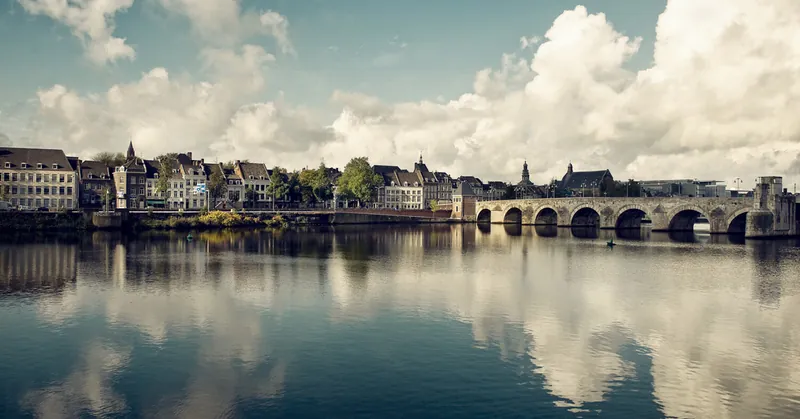
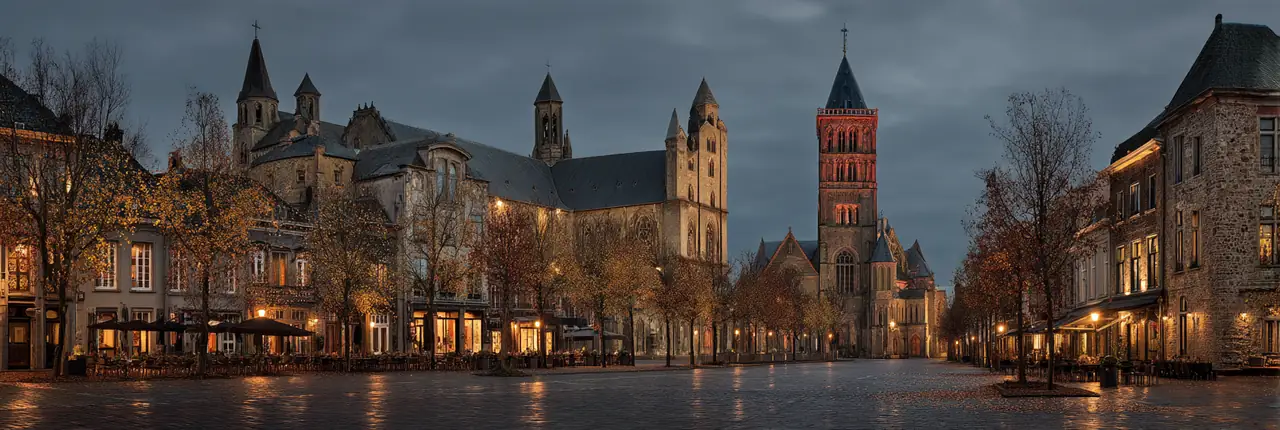
Two buildings in Maastricht taking shape First, the Town Hall on the Markt: the sections swing into place, the lights come on, people converge on the steps from both sides, and a new, glass-fronted building rises up beside it. Next, the St Servatius Bridge: the piers rise from the Meuse, the arches close, the lanterns light up and two groups walk towards each other from both banks until they meet in the middle. Town Hall · Market Square I · Town Hall · Consultations are taking shape II · St Servatius Bridge · two banks, one table

Territory

Maastricht connects three countries

the Netherlands, Flanders and North Rhine-Westphalia: over 43 million people, a single urban network spanning three borders. Maastricht lies at the centre. Tribunal is rooted here and looks across every border from this vantage point.

Tristate City

Three countries, one urban network

over 43 million inhabitants

The Netherlands, Flanders and North Rhine-Westphalia, viewed as a single city. Not an administrative level, but a way of looking at things: anyone who lives, works, conducts research or runs a business here looks across three borders.

Maastricht lies at the centre. Brussels, Cologne and Düsseldorf are all within 100 kilometres as the crow flies.

Sources: CBS (1 January 2026, provisional), Statbel (1 January 2026), IT.NRW (end of 2024). Distances as the crow flies from the Vrijthof.

The Netherlands

The country beyond the Meuse

18.1 million inhabitants

An economy worth over 1,100 billion euros. The Wennink Report sets out what the country needs to do; the border region is barely mentioned. That is where Tribunal comes in.

Sources: CBS, population 1 January 2026 (provisional), GDP 2024: €1,122 billion; the Wennink report, December 2025.

Flanders

Across the Meuse lies Belgium

6.9 million inhabitants

Belgian Limburg borders Maastricht; Hasselt is 26 kilometres away, Antwerp and Brussels less than 100. The same language, a different system.

Source: Statbel, population of the Flemish Region on 1 January 2026: 6,898,350.

North Rhine-Westphalia

The largest federal state, right next door

18.0 million inhabitants

Germany’s most densely populated federal state. Aachen is 29 kilometres away, Cologne 90, and Düsseldorf 87. A market as big as the whole of the Netherlands, just across the border.

Source: IT.NRW, population on 31 December 2024: 18,034,454.

Euregio Meuse-Rhine

Five regions, three countries, one area

± 4 million inhabitants

South Limburg, Belgian Limburg, the Province of Liège, the German-speaking Community and the Aachen region. Around 250,000 businesses, five universities and approximately 110,000 students. Cooperation since 1976.

Sources: IHK Aachen (population, businesses); YouRegion, 2020 (universities, students).

Maastricht

The connector

1992 Treaty of Maastricht

On 7 February 1992, the treaty establishing the European Union was signed here. Today, Limburg is home to four Brightlands campuses: Chemelot, Maastricht Health Campus, Greenport Venlo and the Smart Services Campus. Maastricht University’s ITEM Institute assesses the cross-border effects every year.

Tribunal has deep local roots. From here, we bring that strength together around one table.

Sources: Treaty on European Union (1992); Brightlands; ITEM, Cross-Border Impact Report 2025.

Select a country, the Euregio or Maastricht to view the figures. Boundaries: © EuroGeographics (Eurostat GISCO, NUTS 2021).
  1. Capitalise on it. Knowledge, capital and businesses are already there: Aachen, Liège and Hasselt within 30 kilometres, Brussels, Cologne and Düsseldorf within 100.
  2. Accelerate. One table instead of three systems waiting for each other. What gets bogged down across the border is brought together here on a single agenda.
  3. Building on progress. Every decision becomes the starting point for the next session. In this way, the network grows with every border it crosses.

Recital I

Why now?

Which decision in your company or organisation has been pending for over a year? A more robust partnership, a joint cross-border approach, an investment in research or production? The Netherlands faces the same problem. It knows what needs to be done, but takes too long to make decisions and implements them too slowly.

The Wennink Report paints a picture of a country with knowledge, strong businesses and experience in collaboration. What is lacking are choices and the courage to push them through together. Decisions remain on the back burner. New regulations are constantly being introduced. Responsibility is fragmented, and anyone seeking to resolve an issue ends up in yet another consultation. This is not a rejection of regulations or of the government. The administration itself sits at the table, as a party that shapes the playing field.

Around 14,000: the queue for the electricity grid

companies and organisations are waiting to be connected to the electricity grid. In 2022, the figure was less than 700.

8 to 12 weeks: the time taken to obtain a planning permission

is the time it takes to obtain a standard planning permission in the Netherlands. In China and the United States, the median is under two weeks.

0.5 to 0.9 per cent: expected annual growth

DNB and CPB expect annual growth of this magnitude in the medium term. At least 1.5 to 2.0 per cent is required.

From the Wennink report, ‘The Path to Future Prosperity’, December 2025.

Delay comes at a price. What will it cost your company if a competitor elsewhere produces faster and more sustainably? What does it cost your research if it never makes it to the shop floor? What does it cost the city if talent trained here goes on to build elsewhere? Those who do not invest today are passing the bill on to future generations. What the Euregio fails to decide today, others will decide for it.

The report also shows when things do move quickly. This happens when parties feel the same sense of urgency and set aside their own interests for a single goal. It is precisely this condition that a ‘Zitting’ establishes: one case, one shared question, and a ‘Uitspraak’ with names attached.

Your decision, which has been pending for a year, could become a case. In the documents, you can read how we bring a case to the table. Requesting them costs nothing and entails no obligation.

Photo: Hugo Thomassen, Maastricht Marketing

From the Rules of Procedure

A tribunal does not adjourn without reaching a verdict. Neither do we.

Consideration II

How a Session is conducted

Had enough of meetings that lead nowhere? A Session is structured differently. One hundred minutes, one case, at least 80 per cent discussion, and it’s not over until a Ruling has been reached.

Then the connections: who speaks to whom, with names included. This is how the decision reaches the city.

You’re familiar with the drinks reception, the breakfast meeting and the conference. That’s where you exchange business cards and make New Year’s resolutions. At Tribunal, you go home with a ‘Ruling’: a framework, steps and connections, complete with names. No never-ending process, no resolution that ends up in a drawer.

The Course of a Court Session, 100 minutes

  1. In advance: Documents. The court registry sends the case file and three key questions to everyone at the table.
  2. 10 mins Opening and argument The rapporteur delivers a single five-minute argument. There is no second argument.
  3. 10 mins Situation: The facts on the table. What do we know for certain?
  4. 20 mins Problem: The real sticking point, identified by name.
  5. 30 mins Implications and solutions: What the cost would be if nothing changes. Followed by model solutions.
  6. 20 mins Benefits: What each solution delivers, and for whom.
  7. 10 mins Ruling The framework is in place. Steps and connections are named. The court clerk records the ruling.

Members prepare

The rapporteur works out the key steps in advance. Everyone at the table reads the documents. This ensures the session gets straight to the heart of the matter, rather than starting from scratch. Your time is spent on reaching a decision.

One presentation, five minutes

This is followed by the Questioning, in fixed rounds: situation, problem, implications and benefits. First the costs of doing nothing, then the solutions.

No conclusion without a ruling

During the Deliberation, the group derives the framework itself, works it out and sets it down in writing. With names: who does what, and who speaks to whom. Every task has an owner and a deadline.

Read the full Rules and Regulations

Would you like to see a ‘Zitting’ in paper form first? The documents contain the agenda, the case study and the three key questions. You can read them at your leisure and decide afterwards.

Recital III

The six dossiers

Major issues are spread across too many working groups. That is why we are working on six dossiers. The Wennink report is our starting point, not a legal code. We take it further.

Each dossier begins with a diagnosis from the report. What we add comes from the table: the border with Belgium and Germany, education in the region and the tradition of consultation. In this way, a national report becomes work for the Euregio. Each card features the question with which the next Session could open. Do you recognise this question from your own work?

In your application, select the dossier that is relevant to you. This will let the registry know which case you wish to read first. This field is optional; you are under no obligation to commit to anything.

Recital IV

The foundation: the Wennink report, translated for Maastricht

The Wennink report builds the prosperity of tomorrow on four domains and four preconditions. That is our foundation. For each field, a single sentence here sets out what it could mean for Maastricht. On the Cases page, we work out each field in detail, with sources, and build five cases on them.

Four domains

  1. 1

    Digitalisation and AI

    AI that delivers something for SMEs in the region: applying it, not just researching it.

  2. 2

    Security and resilience

    The continuity of businesses that depend on electricity, ICT and supplies from across the border.

  3. 3

    Energy and climate technology

    Chemelot and the Meuse: industry and river that must become sustainable at the same time.

  4. 4

    Life sciences and biotechnology

    The Brightlands Maastricht Health Campus: from research to growth company.

Four preconditions

  1. 5

    Permits and regulation

    Rules from three countries: for trains, for the river and for those who work across the border.

  2. 6

    Talent

    Enabling talent that studies here to build here as well, and more young people in mathematics and engineering.

  3. 7

    Affordable and reliable energy

    A grid in South Limburg that will only truly expand between 2028 and 2034.

  4. 8

    Economic infrastructure

    Connections across two borders: the railway to Liège and Aachen, the Meuse, the road to Eindhoven.

Based on the Wennink report, De route naar toekomstige welvaart, December 2025, chapters 3 and 4. The sentence for each field is our reading for Maastricht.

See the five cases for Maastricht, with an example Ruling

Which field affects your work the most? Request the documents, or discuss it first with one of the organisers. A discussion about your issue, not a quote.

Recital V

Five roles, one table

Science, industry, technology and government each view the same issue from their own perspective. We bring people together based on what they contribute to the discussion, not on their titles. Five roles, one case study, one Ruling.

  • The entrepreneur who wishes to leave a legacy

    Sphinx, ENCI and the university helped build Maastricht; you want the city to build the next era itself. A cheque is not enough for you, nor is a discussion group. As the linchpin between business, academia and government, you see the blueprint and, drawing on your experience, help shape an idea in Maastricht.

  • The industrial innovator

    Is a competitor elsewhere producing faster, more cheaply or more sustainably, and are you struggling to find young technical talent? Here, there’s no brainstorming and no research project without a product. The framework must be feasible on your shop floor: process improvements that you can prototype quickly and that are commercially viable. You’ll go home with concrete steps and names to follow up on.

  • The scientist seeking impact

    Does your research need to achieve more than just a place in a journal? Here, your work moves from publication to realisation, through cross-fertilisation with industry and governance, without diluting the underlying rationale. Whether your lab is in Maastricht, Aachen or Eindhoven, this is where the link to the companies of the Tristate City lies. Your contributions remain protected within balanced partnerships.

  • The Euregional leader

    Does the border hold back what the Liège–Maastricht–Brussels axis can achieve together? You are the architect of the playing field; at the table sit the entrepreneurs and researchers who want to build on it. In this way, a local case study becomes a building block of the Urban Economy at a macro level. Neutral ground, no lobbying for any single interest.

  • The digital architect

    Prefer building to meetings? A case study is your test environment: you put your architecture through its paces against a real-world challenge, with the people who decide on the next step. What stands the test here can scale from Eindhoven and Aachen to Cologne. Your code and your concepts remain yours, on your own infrastructure.

Not for everyone

  • Anyone here to sell won’t be welcome.
  • Those who only wish to listen will find a better platform elsewhere.
  • Those who join us must prepare. That is the price of a good Uitspraak.

Questions about your research, your code, your figures or lobbying? Read our answers, straight to the point. Do you recognise your role? Read the documents and judge for yourself whether the case suits you. You can then decide whether to join us.

Maastricht and the Euregio

Rooted in the city. Around the table with the Euregio.

Entrepreneurs, scientists, administrators and technologists. One case at a time, and a verdict every time.

Register

Contents of these regulations

Each page is a section of our regulations. From here, everything is just one click away.

  1. Title I

    The Session

    The Regulations by article, the process flowchart and each stage with example questions.

  2. Title II

    Dossiers

    Six case files from the Wennink report. What the report says, and what we add.

  3. Title III

    Cases

    Five questions for Maastricht along the Wennink report: the Three-Country Train, the Maas, growth, an AI accelerator and Maastricht Valley.

  4. Title IV

    The Origins

    Why Tribunal exists, what the name implies and the city’s heritage.

  5. Title V

    Members

    Who helps build it, three types of membership and what members receive.

  6. Title VI

    De Essentie

    One minute every week: four sentences, three questions, one key idea. No newsletter, no answers.

  7. Final Provision

    Receive an invitation

    Documents by email or a call-back request. Two fields, no obligation.

  8. Appendix

    Privacy statement

    What we do with your data – and what we don’t.

Final provision

First, the documents. Then your decision.

Would you prefer to read them first? Then we’ll send you the documents by email. Would you prefer to speak first? Then one of the organisers will ring you at a time that suits you. A discussion about your issue, not a sales pitch. Just two fields to fill in, and you decide for yourself whether to join us.

Choose how we contact you. Both options are non-binding.

Fields marked with * are compulsory.

No newsletter, no resale. Your enquiry goes directly to the registry.

You will hear from us within five working days, by email or by telephone at the time you have chosen. Your request will be treated confidentially. Requesting the documents is free of charge and does not entail any obligation. No newsletter, no resale. First Session: [date of first Session to follow], [venue to follow].