Bringing key players together: local, adaptive and goal-oriented.
Making real progress requires more than just informal discussions. A valuable Session is goal-oriented, driven by a clear purpose and underpinned by a robust structure. By exploring the issue interactively, key players come to agree on concrete steps and a binding Ruling.
The Euregio has no shortage of ideas and research. What it lacks, however, is the moment when these become something tangible.
In Maastricht and the Euregio, universities, family businesses, the manufacturing sector and three countries are all situated in close proximity. Yet everyone tends to speak mainly within their own circles: entrepreneurs with entrepreneurs, researchers with their peers. Lawyers, engineers and business economists each approach the same issue from their own perspective.
You know the result: lots of discussion, few decisions. A meeting ends with good conversations and a follow-up appointment. Afterwards, nobody knows who is going to do what. Nothing ever gets off the ground.
Procrastination comes at a price. Initiatives in Maastricht are fragmented, each with its own consultation process. Talent trained here goes on to build elsewhere. Research fails to reach the practical world. And what the Euregio fails to decide, others decide for it. The Wennink report puts it this way at national level: inaction is also a choice. The next generation will foot the bill.
From the Wennink Report, ‘The Path to Future Prosperity’, December 2025.
We want to act as a catalyst to leave behind a world for our children that still has something to offer, through smart systems thinking.
The founding principle of Tribunal
That is why Tribunal acts as a catalyst. What you bring to the table counts: knowledge, capital or mandate. Every Session concludes with a Ruling setting out specific steps and connections: who speaks to whom, and about what.
Why this will not be a lecture-style session
One case per Session, with one clear problem. No open agenda.
One five-minute plea. Followed by the cross-examination: rounds of questions, taking up at least 80 per cent of the time.
The rapporteur prepares the key steps. The registry sends out the documents in advance, along with three key questions.
No conclusion without a ruling: the framework that guides the group, setting out the next steps and who will speak to whom. This ensures a clear blueprint is in place afterwards.
A discussion without an obligation to reach a conclusion rarely yields anything. The name is therefore a protocol: one case goes in, a Ruling with steps and connections comes out. In Rome, a tribunal was the platform of judgement.
The word comes from Latin. A tribunal was the raised platform upon which Roman magistrates sat to pass judgement. The word derives from ‘tribunus’, the tribune. Later, it also came to mean a court of law.
Most networks end in a conversation. A tribunal must not do that: it reaches a verdict. We take on that duty. Not to judge people, but to get to the bottom of a problem, with the thoroughness of proper investigation.
The judgement is passed on the problem, never on the people at the table.
This is how the name translates into ‘The Session’, in accordance with a strict principle of problem-based learning:
I
Documents
The registry sends the case study and three key questions in advance. You arrive prepared.
II
Plea
The rapporteur opens with a single five-minute presentation. No slides.
III
Questioning
Rounds of questions: situation, problem, implications and what a solution would achieve.
IV
Deliberation
The group derives the framework and elaborates on it.
V
Decision
The framework, the next steps and who will speak.
VI
Secretariat
The secretariat records the ruling to ensure that nothing is lost.
Would you like to check first whether the method works? In the documents, you can read the case study, the three key questions and what you’ll take away from it. No obligation, by email.
Knowledge, capital and mandate are not sufficiently aligned in the Euregio. These three pillars explain why Tribunal is bringing them together in Maastricht.
Triple Helix
Research without capital remains confined to the laboratory. That is why academia, industry and government sit around the same table. Tribunal works closely with people from Maastricht University. In this way, research comes together with capital and mandate in the same place.
For you: your research finds an application beyond the pages of a journal, and a real-world question finds the right researcher. You decide for yourself what you share. The framework is set by the round table. Your own work remains yours: your research, your code, your platform.
The report states that the Netherlands knows what needs to be done, but is too slow to decide and deliver. Speed does, however, prove possible where parties feel a shared sense of urgency and rise above their own interests. That is precisely what a Zitting calls for.
For you: an agenda with national significance, tailored to Maastricht. We use the report as a starting point, not as a rulebook. We’ll take it further.
To the Wennink Report, ‘The Path to Future Prosperity’, December 2025.
De-pillarisation
For a long time, the Netherlands was divided into pillars. The leaders of those pillars resolved disputes together, around the negotiating table. From the 1960s onwards, the pillars began to break down. In people’s minds, they still exist: each sector looks at things from its own perspective.
For you: cross-fertilisation between disciplines, focused on a single question. We take the best of consultation and leave the red tape behind.
Which dossier is most relevant to your work? You’ll choose it later in your application.
Art. IV. Heritage
A city accustomed to making decisions
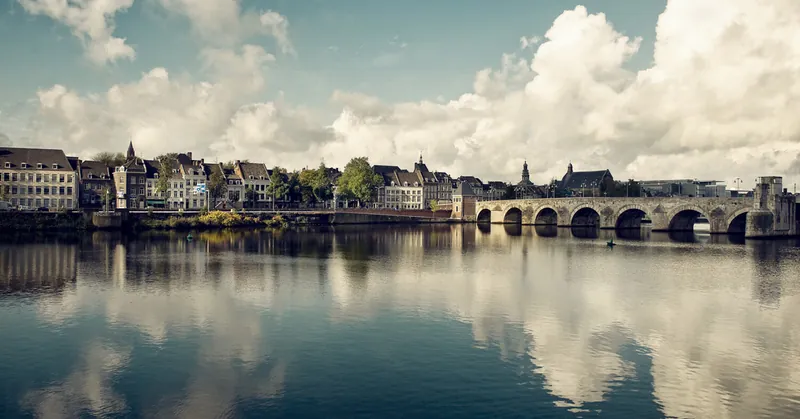
Heritage disappears if no one builds on it. For centuries, Maastricht administered justice, built factories and lent its name to a treaty for Europe. Tribunal builds on that legacy.
For centuries, Maastricht had two rulers: Brabant and Liège. The town hall on the Markt was therefore built in two equal halves. It served as both the seat of government and the seat of justice. Two parties, one building, one outcome: that is how we also view a Session.
c. 1470
The Dinghuis
Built around 1470 as the courthouse of the city under dual rule. Justice was administered here.
1659
The Town Hall on the Markt
Built from 1659 onwards to a design by Pieter Post. Administration and the administration of justice under one roof.
1834
Regout, later Sphinx
Petrus Regout set up a glass and crystal business. This grew into Sphinx, and Maastricht became a city of factories and craftsmanship. That industry brought prosperity as well as hard labour; both are part of the story.
1926
ENCI
Extracted marl from the Sint-Pietersberg. Marl extraction ceased in 2018. The quarry is largely being returned to nature. A city that brings an era of industry to a close and starts afresh.
1976
Maastricht University
Founded as the University of Limburg. Adopted problem-based learning as its teaching method. Tribunal follows the same approach: a specific problem, a brief introduction, questions in rounds and jointly developing a framework.
1992
Treaty of Maastricht
On 7 February 1992, twelve countries signed the treaty establishing the European Union at the Gouvernement.
Heritage is not a museum piece. The city of the Treaty demonstrated that Europe can function as a unified whole across borders. The question is what this generation will leave behind. Tribunal continues what Maastricht began, and invites you to help shape it.
Art. V. The table
Who’s at the table?
Is it worth your time? That depends on who’s there. A session is local and straightforward, with people from your own region. By the end, you’ll know who can help you further.
Entrepreneurs,Academia,Governance:One issue, one table; One pitch, five minutes. Situation,Problem,Implication,Outcome,Insight.Framework:Roles by name:Entrepreneur,Academia,Governance,Industry,Digital,Connections
Then the connections: who speaks to whom, with names included. This is how the decision reaches the city.
Seated around the table are people who bring something to the table that the others do not have: knowledge, capital, a mandate or a functioning system. Entrepreneurs and family businesses from Maastricht. Developers of platforms and systems that are already up and running. Researchers from the Euregio’s knowledge institutions. Executives and policymakers from the Netherlands, Belgium and Germany.
Preparation is the norm. The rapporteur prepares the key steps and presents the case. The others read the documents in advance. That way, nobody starts from scratch.
Each Session yields connections between business, academia and government that you would not have made yourself. The secretariat records in the ‘Ruling’ who will speak to whom, and on what topics. Each subsequent session opens with a summary of the previous ‘Ruling’: what has been done, and who spoke to whom. In this way, a single session continues to have an impact on your network.
Curious to know who would be involved in your case? One of the organisers will let you know, either by email or in a brief phone call. You’re simply asking for information; you’re not committing to anything yet.
Based on the tried-and-tested principles of Problem-Based Learning (PBL), designed to facilitate direct decision-making in the Euregio.
01
15–20 minutes’ input
A compelling opening statement opens the Session. No endless presentations – we get straight to the heart of the matter.
02
The ‘why’ and the outcome
Getting to the bottom of what really drives the issue and what tangible value needs to be created.
03
Implications and problem analysis
Thorough investigation from multiple disciplines (triple helix) to uncover the bottlenecks.
04
Discussion rounds and Ruling
Active deliberation resulting in a clear framework, concrete next steps and a clear division of responsibilities.
Final provision
Read first. Decide afterwards.
You’ll receive the documents by email: the case study and three key questions. No phone call. This way, you can decide for yourself whether a Session is worth your time. Would you prefer a chat first? Leave your number. One of the organisers will ring you back at a time that suits you.
Your name and your email address or telephone number. No newsletter, no resale. Your application goes directly to the registry. You’ll hear from us within five working days. Places at the table are by invitation only.